
A capsule wardrobe sounds simple until it has to cope with a British Tuesday. The morning may be crisp, the train overheated, lunchtime bright and the walk home wet. A useful edit therefore cannot be built around one ideal season or a rigid number of garments. It needs to work as a flexible system: light pieces that layer cleanly, outerwear that answers real weather and shoes that still make sense after a shower.
The best starting point is not a shopping list. It is an honest look at how you spend your week. Someone who walks to work needs different outerwear from someone who drives; a home worker may need fewer formal options but more polished knitwear. The aim is to make your most common days easy, then cover occasional events with a few adaptable pieces rather than a separate wardrobe.
Start with your real week, not an ideal one
Look back at the last fortnight and note what you actually wore. Divide those outfits into broad situations such as commuting, office days, home days, weekends and evenings. This quickly reveals whether your wardrobe needs smart trousers, easy denim, dresses or practical layers most often. It also exposes fantasy purchases: lovely items that suit a life you rarely lead.
Next, identify the pieces that caused friction. Perhaps your coat looks smart but cannot handle rain, your favourite trousers only work with one pair of shoes, or your jumpers are too bulky under a jacket. A capsule improves when it solves these repeated problems. It does not improve merely because everything is beige or because the final rail contains a fashionable number of hangers.
- Write down your five most common weekly activities.
- List the garments you reach for repeatedly in each activity.
- Note where weather, fit or care requirements make an outfit fail.
- Set aside occasionwear, sports kit and specialist outdoor clothing before editing everyday pieces.
- Choose a realistic laundry rhythm so the capsule remains usable between washes.
Build a three-part layering system
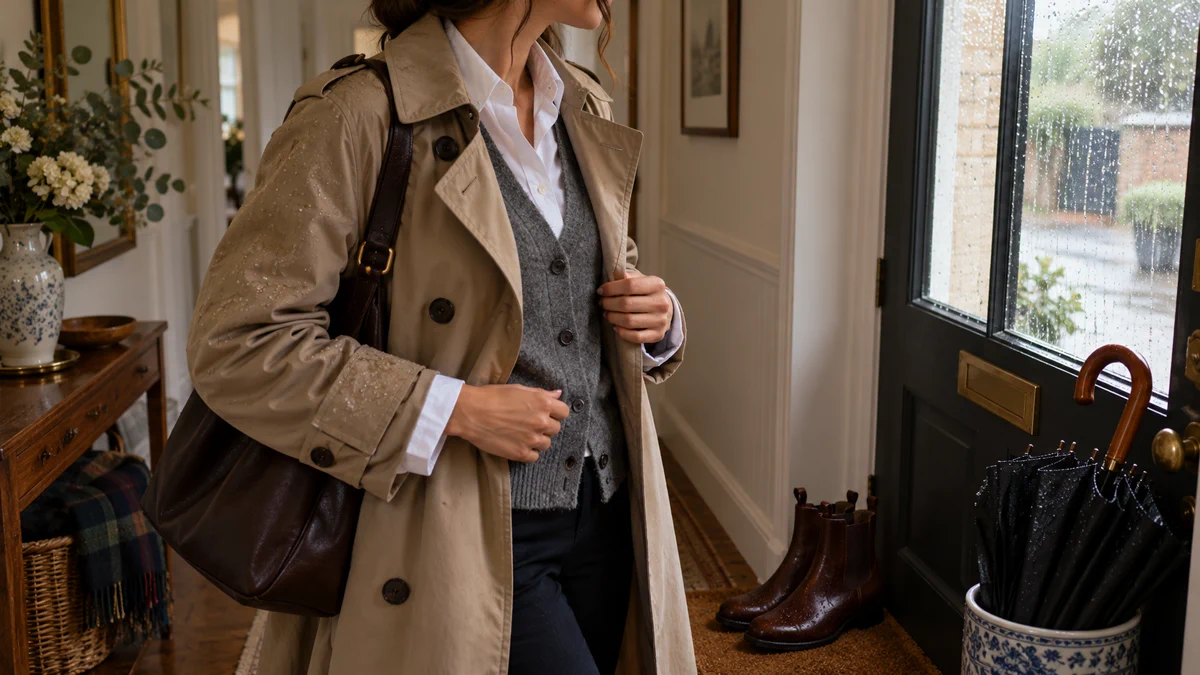
The Met Office describes the UK as having a temperate maritime climate with cool or mild conditions and changeable weather. In wardrobe terms, this makes removable layers more valuable than a single heavy solution. Think in three parts: a comfortable base, an insulating middle and a protective outer layer. Each element should also work independently wherever possible.
Base layers include T-shirts, shirts, fine roll-necks and long-sleeved tops. Mid-layers may be cardigans, fine jumpers, knitted vests or an unstructured blazer. The outer layer deals with wind and rain: a trench, mac, practical waterproof or winter coat. When these categories fit together without pulling at the shoulders or bunching at the sleeves, the same foundation can move through several temperatures in one day.
Choose a palette that creates combinations
A coherent palette makes a small wardrobe feel generous, but it need not mean wearing only neutral colours. Choose two or three grounding shades that suit your existing shoes and coats, then add one or two colours you genuinely enjoy. Navy, charcoal, chocolate, olive and soft cream can all act as foundations; burgundy, cobalt, rust or green can bring energy without making every outfit dependent on a statement piece.
Test potential purchases against at least three items you already own. A patterned blouse might work with dark denim, tailored trousers and a midi skirt; a bright cardigan might sit over a dress as well as with two different bottoms. This simple test is more useful than asking whether an item is a ‘classic’. A classic that does not fit your life or coordinate with your clothes will still remain unworn.
Keep contrast deliberate
Tonal outfits look polished when texture and shape vary. Pair smooth trousers with a ribbed knit, or dark denim with a soft wool jacket. If the outfit contains strong colour contrast, repeat one shade in a small detail such as socks, a scarf or a bag. The goal is not perfect matching, but a visual connection that makes separate pieces feel considered.
Prioritise outerwear for rain and temperature shifts
Outerwear does the most visible and practical work in Britain, so it deserves more thought than an extra top. A light rain-resistant layer covers mild, damp days; a roomier warm coat handles colder weather. Depending on your routine, an unlined trench, hooded mac or technical shell may be more useful than a formal wool coat. The right answer is the one you will actually wear on the school run, station platform or weekend walk.
Try every coat over your thickest normal mid-layer. Check whether you can reach forward, carry a bag and sit comfortably. Look at hood coverage, pocket placement and closure as carefully as colour. ‘Shower-resistant’ and waterproof are not identical promises, so read the care and performance information if you expect prolonged rain. A compact umbrella helps in town, but a secure hood is often better in wind.
Create a hardworking core wardrobe
There is no universal total, but the following core gives a useful framework. Adjust quantities to your laundry schedule and dress code rather than treating it as a rule.
- Four to six base tops, mixing short sleeves, long sleeves and at least one smarter shirt.
- Two or three mid-layers, such as a fine jumper, cardigan and relaxed blazer.
- Three or four bottoms that share shoes and tops, for example dark jeans, tailored trousers and a midi skirt.
- One easy one-piece option, such as a jersey or knitted dress, if dresses suit your routine.
- Two outer layers: one lighter and rain-ready, one warmer for winter.
- Three practical shoe options covering everyday walking, wet conditions and smarter plans.
- A small group of useful accessories, including a scarf and a bag that tolerates drizzle.
This is a base, not a finished identity. Prints, jewellery, vintage finds and favourite colours can sit within it. A capsule should make personal style easier to express because the foundations already work, not flatten every outfit into the same uniform.
Use shoes to make the wardrobe weather-ready
Shoes can undermine an otherwise sensible edit. Suede, thin soles and delicate pale finishes may be fine on dry days, but they should not be the only option. At least one everyday pair should have dependable grip and tolerate wet pavements. Leather boots, treated trainers or weather-resistant loafers can cover different dress codes, provided they are comfortable for the distance you actually walk.
Check whether trouser hems work with each shoe height. Wide legs that skim the floor in trainers may drag in rain; cropped trousers can expose ankles on cold platforms. Small alterations often unlock more combinations than another purchase. A cobbler can also replace worn soles, add protection and extend the life of shoes that already fit well.
Shop gaps slowly and assess quality
After the edit, wear the reduced selection for a few weeks before buying. Keep a written gap list and record the precise problem: ‘fine navy cardigan that fits under mac’ is more useful than ‘new knitwear’. This pause separates a genuine need from the temporary excitement of creating a capsule.
When you do shop, inspect seams, fastenings, fabric recovery and care instructions. Consider second-hand options and alterations as well as new pieces. WRAP’s work on clothing longevity emphasises durability, repair and reuse; those principles align naturally with a capsule, where every item is expected to earn regular wear. A lower-priced garment is not good value if it loses shape quickly, while an expensive item is not sensible simply because it has a prestigious label.
Make a seasonal rotation without starting again
A British capsule works best as a stable core with a small seasonal rotation. In spring, bring forward lighter knitwear and a rain layer. In summer, add breathable tops and perhaps linen-blend trousers, while keeping a cardigan accessible for cool evenings. Autumn calls for boots and richer mid-layers; winter adds thermals, a warm coat and cold-weather accessories.
Store off-season items clean and dry, then review them before they return. Repair loose hems, de-pill knitwear and check waterproofing. This prevents the familiar cycle of buying replacements because useful pieces were forgotten or left in poor condition. It also gives you a clearer picture of what survived the previous year and what genuinely needs replacing.
A final capsule wardrobe checklist
- Can every everyday bottom make at least three outfits?
- Do your normal layers fit comfortably under both coats?
- Is there a reliable option for sustained rain and one for cold weather?
- Can you walk your usual distance in at least two pairs of shoes?
- Does the palette include colours you enjoy, not only safe neutrals?
- Are care demands realistic for your time and budget?
- Have you left room for personality, occasion pieces and changing needs?
A successful British weather capsule is not the smallest possible wardrobe. It is a collection with fewer dead ends: garments that cooperate, layers that respond to the forecast and practical pieces that still feel like you. Build it from your real routine, refine it across the seasons and let evidence from repeated wear guide every new addition.

 狭い 部屋でも 暮らしやすい 余白を つくる 収納の 工夫 <p style=' font-weight: normal; line-height: 1.9rem !important; font-size: 17px !important;'> 床を埋めず、動線と安全を守りながら持ち物の定位置を決める </p>
 Cómo adaptar el estilo boho moderno cotidiano <p style=' font-weight: normal; line-height: 1.9rem !important; font-size: 17px !important;'> Texturas, capas y accesorios bien editados para llevar la tendencia sin parecer disfraz. </p>
 Rutina de armario que ahorra tiempo diario <p style=' font-weight: normal; line-height: 1.9rem !important; font-size: 17px !important;'> Un sistema simple para encontrar, combinar y guardar tu ropa con menos decisiones cada mañana. </p>